Remove Some Files From the Volume and Then Try Again Mac
How To + Recommended
How to Uncover and Delete Hidden Files Cluttering Your Mac and Save Space
Posted on November 17th, 2020 by 
In a recent article, we looked at how you can go rid of duplicate files on your Mac. This is the offset pace toward cleaning out your Mac and freeing upwardly space on your drive. Still, there are more insidious files cluttering your Mac; these can be subconscious in folders yous may non see, or, sometimes, in plain sight. This is peculiarly important if you take a Mac with an SSD and limited storage. In this article, I'1000 going to prove you how to uncover and delete some unneeded files that may exist taking upwards a lot of space on your Mac.
Remove Unused Apps
The first place to look to sweep out unneeded cruft on your Mac is in your Applications folder. When you bought your Mac, it came with a number of applications installed, and you may have downloaded and installed many others. But do y'all use them all? For example, Apple offered yous apps like Pages, Numbers, Keynote, and GarageBand; did you download them, and do you use them? If not, getting rid of them can salve a lot of space.
To meet your applications, open your Applications binder and view your apps as a listing (choose View > as Listing, or click the List View button in the Finder toolbar). To add a column showing the date you last used an application, right-click on the column headers and choose Date Concluding Opened. Click that column header to sort past that date; it will be in descending society, showing the almost recently used apps first. Click that header again to change the sort lodge, showing the apps you haven't used in the longest fourth dimension starting time.
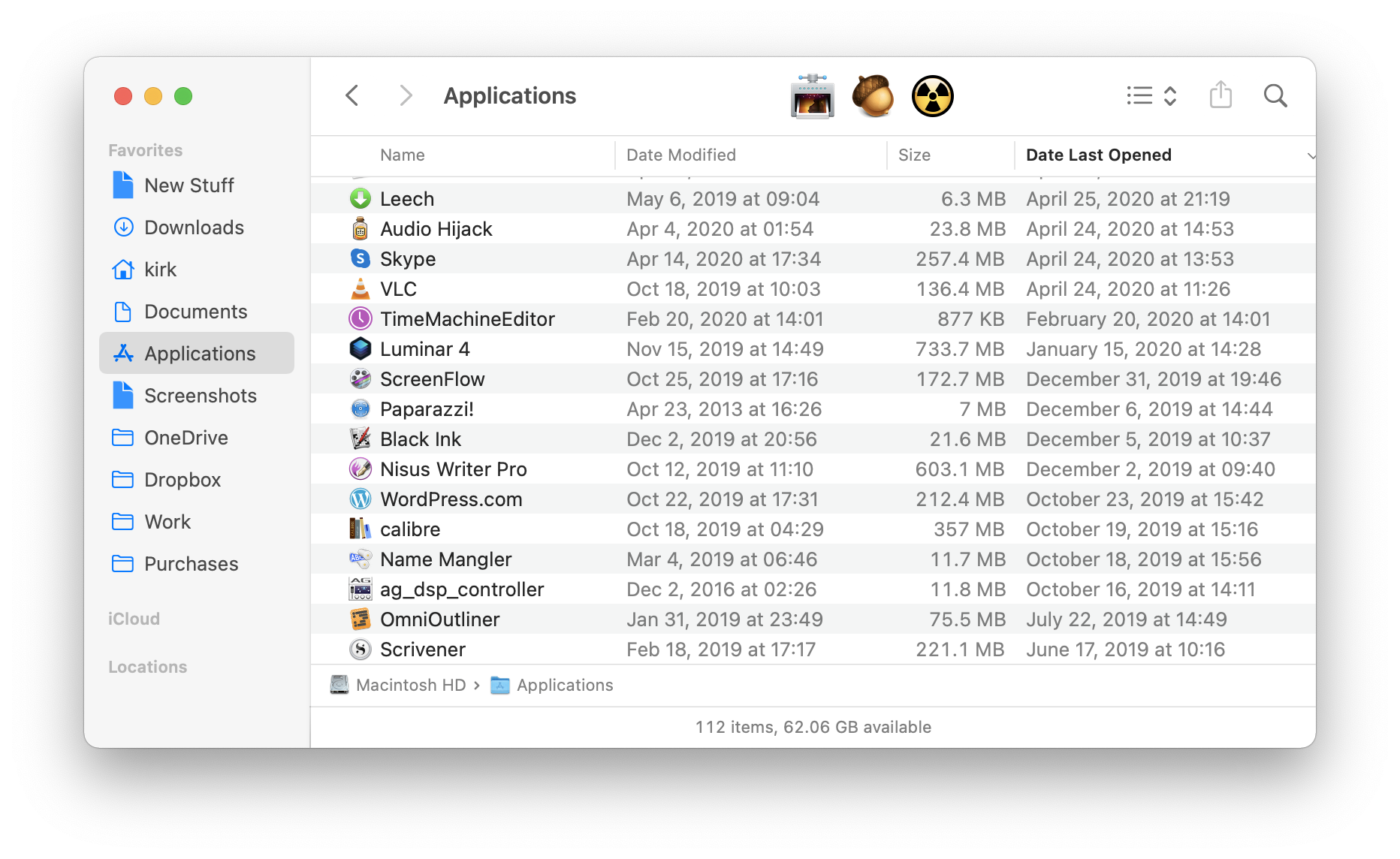
If yous see apps that yous recognize, and know yous don't use whatsoever more than, delete them. Don't delete annihilation if you're not certain; there may be apps that you might need at some point. Nevertheless, you probably have apps that you tried in one case and never used. If you're not sure about any apps, don't delete them; but if you can easily re-download apps, then don't worry besides much.
Note that if you exercise a clean installation when a new major version of macOS is released, these dates will exist no older than the engagement of that update.
Next, sort your apps by size. To do this, click the Size column header. You may accept some very large apps that you don't employ, and some of these may be Apple apps. For example, if you lot've downloaded iMovie and GarageBand, simply don't use the apps, they take up, respectively, 2.77 GB and 1.37 GB. Deleting them saves more than four GB, which is a substantial clamper of space on an SSD. You tin always redownload any apps you lot've bought or downloaded from the Mac App Store; for other apps, ones that you may have bought direct from developers, it's best to concord on to them if y'all're not sure.
Delete Caches
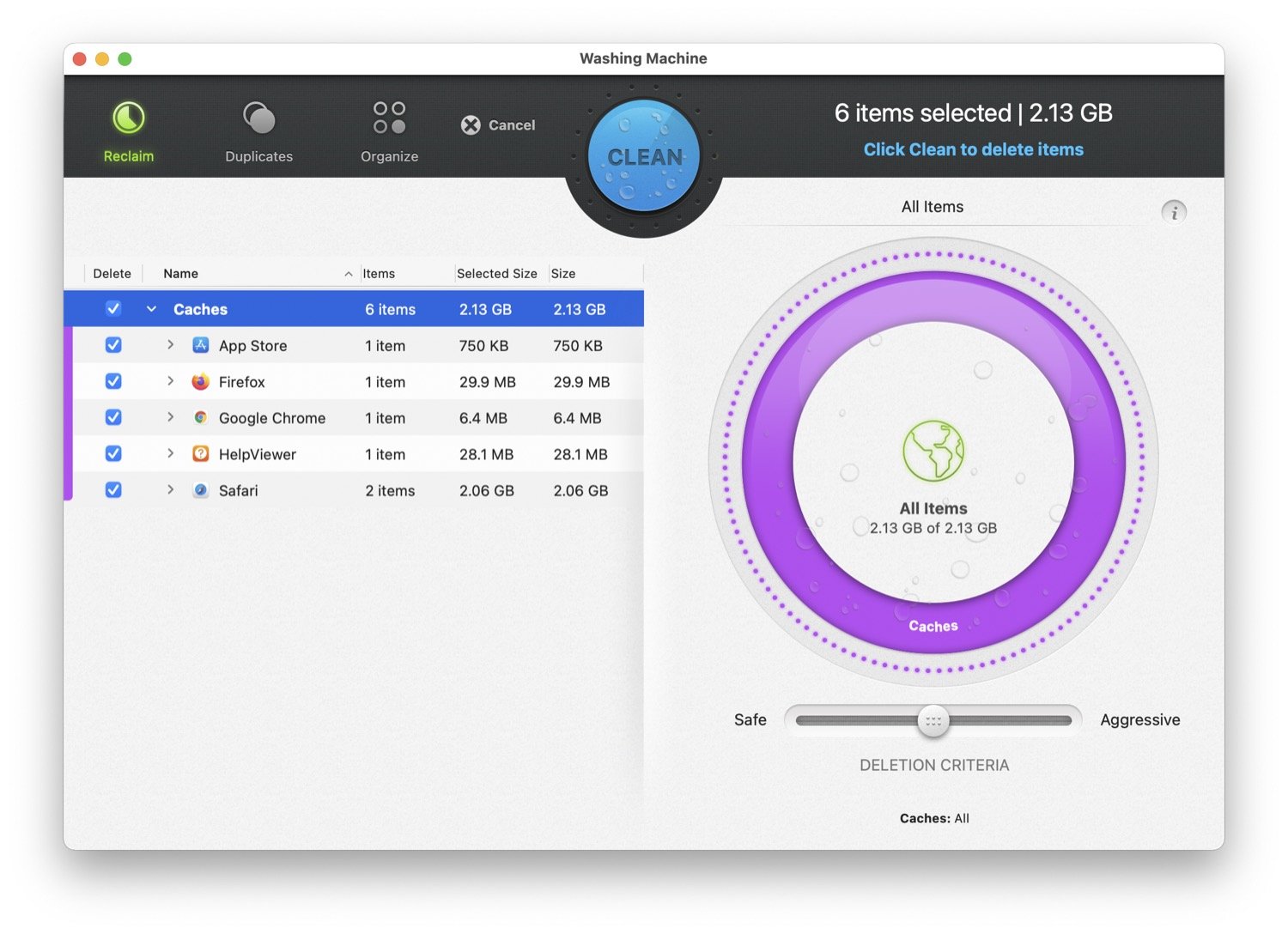
Intego's Mac Washing Auto, available on its own, or in a packet every bit Mac Washing Machine Secure X9, which includes Internet security software, or every bit office of Mac Premium Bundle X9, has many useful features to help yous reclaim space, weed out duplicate files, and more than.
One of the most useful features of Mac Washing Machine finds and deletes caches; these are folders that incorporate temporary files that certain apps write to help speed up performance. For case, your Web browser caches files it has viewed, and then it may non need to re-download them when you visit a spider web page again. All the same, these caches can add together up, and since you don't return to most web pages, y'all can salvage a lot of infinite by deleting some of them. In the screenshot below, y'all can see that Mac Washing Machine tin save more than 2 GB on my Mac, just by deleting unneeded caches.
Next, if you lot become to the Library binder in your home folder (that's the binder with the house icon and your user name), you'll see lots of surprises. To view this folder—it might be hidden on your Mac—choose the Go card in the Finder, printing the Option key, and then choose Library.
This Library folder contains a lot of files you lot generally don't need to encounter, but some of them take up a lot of space and can exist deleted. View this folder in Listing View, and and so click the Size header to view the largest folder beginning—information technology volition probably exist the Application Support folder. The Application Support folder holds files that some apps need to run.
While there are a number of files you could delete here, it's best to be conscientious. I'll mention just a few folders you lot can safely delete. For instance, at that place is the Caches binder.
As I explained to a higher place, the Caches folder contains temporary files. You tin delete this folder, merely you should restart your Mac immediately after you do so, since some apps may recollect certain cache files are withal present.
The Containers folder contains many important files, just also some you lot may not need. Please don't delete things at random here; for example, the com.apple.BKAgentService folder contains the contents of your iBooks library. But there's one you should check; it'due south in com.apple.mail, and its full path is as follows:
~/Library/Containers/com.apple.mail/Information/Library/Post Downloads
This folder contains attachments that y'all have viewed in email messages, but that Mail neglects to delete. (There's a setting in Mail's General preferences nigh removing unedited downloads, but it often doesn't work.) If yous become a lot of emails with attachments, viewing those attachments places copies in this folder. For some people, there can be several gigabytes of files. Open up this folder, sort by date, and delete any folders that are very old (each attachment is in a folder with an unrecognizable proper noun).
iOS Device Backups
You may take spotted a MobileSync folder in the Application Support binder. This folder contains iOS device backups fabricated on your Mac. With the replacement of iTunes by four apps in macOS Catalina and later, iOS device backups are now handled by the Finder. (If y'all just back up your iOS devices to iCloud, and so this folder won't be very large.) You may take multiple backups of your iOS devices, which take upward a lot of space.
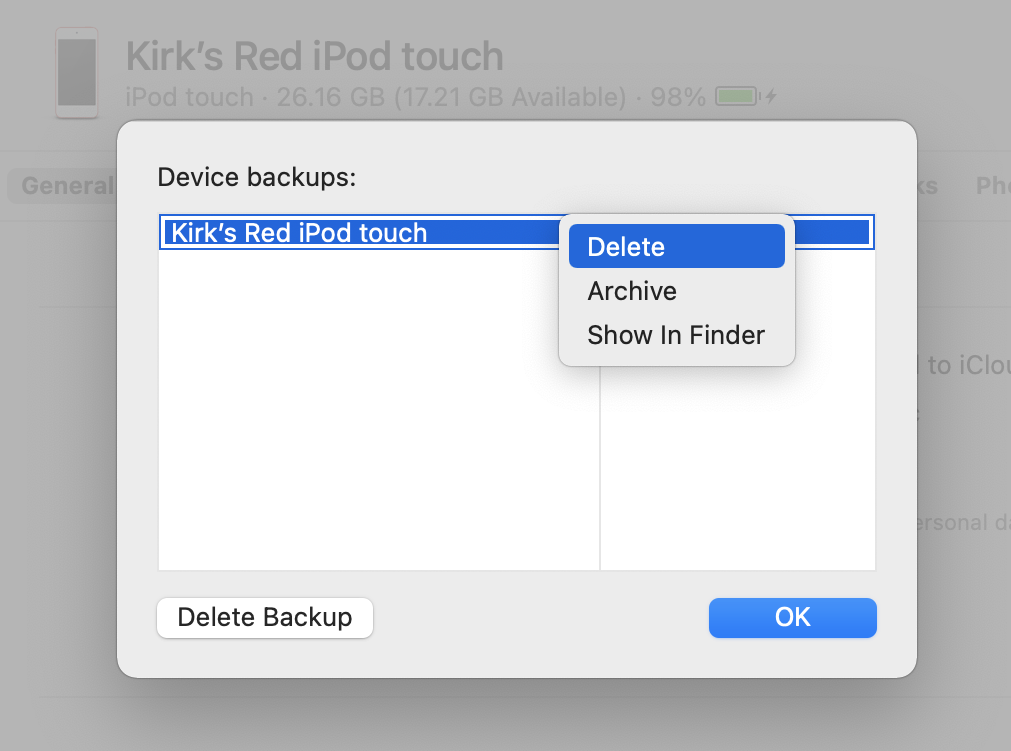
To manage these backups, connect an iOS device to your Mac, then, in the Backups section of the Full general screen, click Manage Backups. At that place you'll encounter a listing of backups. If you run into more than i for any device — some might be very old — click the older backups and click Delete Backup. Also, if you see backups for devices you no longer ain, delete them as well. This could save several GB. You can run across how large each fill-in is past right-clicking a backup and choosing Evidence in Finder.
Restart Your Mac
Finally, you may discover, if y'all've had your Mac running for a long time—days or weeks—it loses some space. This is because macOS writes virtual memory files to disk. Sometimes, if you are using memory-intensive apps and don't have a lot of RAM, these files can be quite large. Just restart your Mac to reclaim space. In general, you can but put your Mac to slumber when y'all're non using information technology, and not restart information technology for weeks, but if you're running depression on space, you might want to restart it more often.
Check each of the above, and you can salve a lot of space. If you don't have much storage on your Mac, you'll reclaim plenty of gigabytes.
How can I learn more than?
 Each week on the Intego Mac Podcast, Intego's Mac security experts discuss the latest Apple news, security and privacy stories, and offering practical advice on getting the most out of your Apple devices. Be sure to follow the podcast to make sure yous don't miss whatsoever episodes.
You tin can likewise subscribe to our email newsletter and keep an centre here on Mac Security Blog for the latest Apple security and privacy news. And don't forget to follow Intego on your favorite social media channels: Facebook, Instagram, Twitter, and YouTube.

About Kirk McElhearn
Kirk McElhearn writes about Apple products and more on his weblog Kirkville. He is co-host of the Intego Mac Podcast, as well as several other podcasts, and is a regular contributor to The Mac Security Blog, TidBITS, and several other websites and publications. Kirk has written more than than 2 dozen books, including Accept Control books about Apple'southward media apps, Scrivener, and LaunchBar. Follow him on Twitter at @mcelhearn. View all posts by Kirk McElhearn →Source: https://www.intego.com/mac-security-blog/how-to-uncover-and-delete-hidden-files-cluttering-your-mac/
0 Response to "Remove Some Files From the Volume and Then Try Again Mac"
Publicar un comentario