The Art of War Sun Tzu Commandant's Reading List
in: Living, Reading
• November 11, 2021
The Best of the Marine Corps' Reading Lists
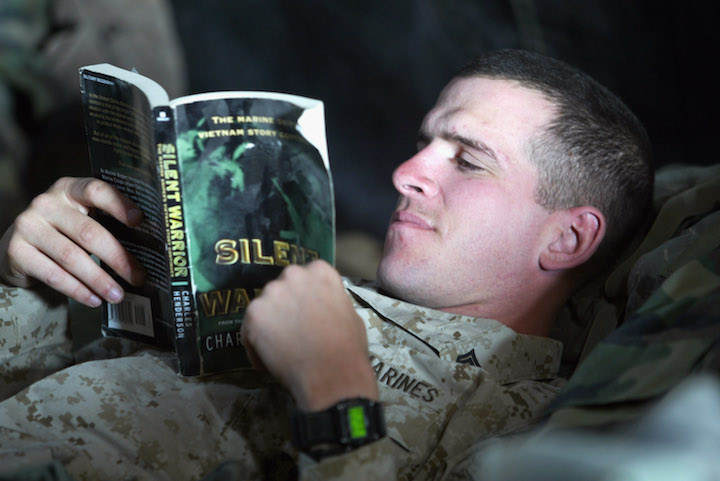
From aboriginal times til the nowadays, the ideal warrior has been celebrated as a man of both thought and action, with a mind as finely honed equally his sword. Since the 19th century, the Marine Corps has directed its members to pursue that ideal by issuing a listing of recommended reading to members of its fighting force. In 1989, the reading list was codified, and since then, each commandant (the highest-ranking officeholder in the Corps) has put out the "Commandant'south Professional Reading List" each twelvemonth. The goal of the list is to better Marines' agreement of their profession, the nature of war, and the broader world, and develop their decision-making skills, desire for lifelong learning, and power to wrestle with bug. The books are to be read by enlisted personnel and officers alike, with commanders encouraged to hash out the books with their men.
In the reading list issued in 2005, four-star general and commandant Michael W. Hagee shared the criteria by which the books were selected for recommendation:
A. THE List DOES Non INCORPORATE FLEETING TRENDS.
B. It EMPHASIZES WARFIGHTING.
C. Information technology IS HISTORICALLY BASED.
D. IT USES SERIOUS LITERATURE THAT HAS AN ESTABLISHED PERMANENCE.
E. IT ENCOMPASSES A Wide CONTEXT.
F. AND, Information technology IS ACHIEVABLE BY ALL MARINES.

In 2012, Commandant James F. Amos sent a alphabetic character to the Corps which reiterated that "the development and broadening of the mind is a critical attribute of the true warrior'southward preparation for boxing" and argued that the source of the "accommodation and flexibility shown by Marines faced with a variety of different situations and challenges" could be traced to this commitment to intellectual growth. Amos expressed concern over the fact that many Marines of the time had dropped the reading habit — in part because of the pressures and time constraints generated by over a decade of continuous combat in Iraq and Afghanistan — and chosen for a reemphasis on reading throughout the Corps:
Faced with a period of fiscal thrift and an uncertain world, information technology's more of import at present than ever before to dedicate time to read and to think. As we fix ourselves for whatever is to come, the study of military machine history offers the cheap take chances to learn from the difficult-won experience of others, find a template for solving existing challenges, and avoid making the same mistakes twice. . . . Whatever book thoughtfully read sharpens the mind and improves on an private's professional potential.
Whatever has acquired our emphasis on reading to atrophy, nosotros as Marines and as leaders, need to restore its preeminence at every level. . . .
Commanders and senior enlisted will reinvigorate the disquisitional emphasis on reading in their units and develop a unit reading program. Books volition be selected for reading and discussion, with fourth dimension set aside in the schedule to that end. . . .
Reading is a critical continuing activity. We need to find the time for it just as we observe time weekly for private and unit physical conditioning. What I am calling for is aught less than a renewal of a critical aspect of our commitment to the profession of arms.
The Commandant's Professional Reading Lists included a set up of books designated as the "Commandant'south Choice" — favorites he felt were pertinent to all Marines — as well as sets of recommended books broken down past rank, east.g., an enlisted private was given a different list of books to read than a 2d lieutenant. All Marines were required to read a certain number of books from the Commandant'south Selection list and/or their "Grade Level" list. One time a Marine had read all the books assigned to his grade, he could go along reading up the list.
While at that place are a few books that made it into nigh every edition of the CPRL, every few years the listing is revised, with books added and taken abroad from the line-up based on the commandant's personal picks, the feedback of rank-and-file Marines, and the desire to create a list of books which speaks to the current centers of conflict and particular problems of a period. So, for example, books nearly dealing with PTSD and the way engineering is irresolute warfare have been added in the last decade, while books that covered the history of the Corps, but only upward through the 20th century, were replaced with more upwards-to-date publications.
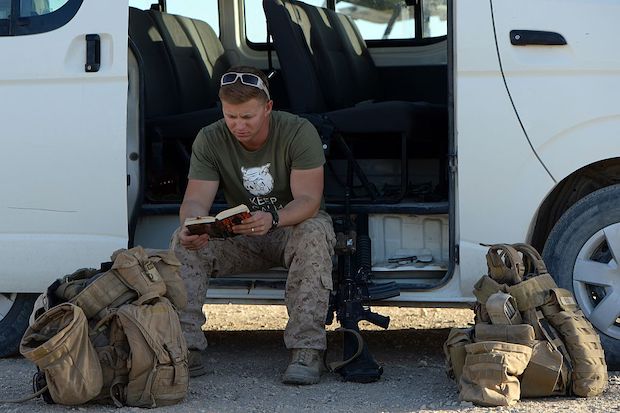
In recent years, the list got a little "lighter" in heft, with fewer entries on history and logistics, the emptying of classic books on strategy by Sun Tzu and Clausewitz, and the addition of popular psychology books like Malcom Gladwell'south Outliers and modern novels like Ready Player One. But overall, the CPRL maintained a solid mix of books on leadership, tactics, and martial history.
And so in 2020, the Commandant's Professional Reading List underwent a more significant overhaul. The CPRL was simplified to a single list for all Marines, regardless of rank, and organized into 5 categories (Foundational Documents, Profession of Arms, Innovation, Leadership, and Strategy). Its entries were revised with the official aim of ensuring the list "remains relevant, current, and promotes professional discussions amongst all Marines." To that end, many historical and biographical books which had been included on nearly every CPRL of the last thirty years went missing (including must-reads like With the Onetime Breed), books focused on female Marines and emotional intelligence (e.chiliad., Dare to Atomic number 82 by Brene Brown) were added, and the number of pop psychology books was increased overall. The fiction selections (like the formerly perennial inclusion of classics such as Once an Eagle and All Placidity on the Western Front, as well as modern page-turners like Steven Pressfield's Gates of Fire), which e'er comprised a smaller but all the same significant portion of each CPRL, were reduced to a single graphic novel.
As with many things, change isn't always an unmitigated good, and the by CPRLs were arguably much superior in content, depth, and range. Below nosotros highlight 36 of the best books from all the Commandant'south Professional Reading Lists that were issued from 1989 until 2019 (you can discover all the previous Marine Corps' reading lists here), nearly all of which we've read ourselves and tin can personally recommend. Whether you're military or civilian, perhaps you lot'll see a few you'd like to add to your own to-read list. As General Amos put it, in all life'south battles, "mental preparation [is] as important as physical conditioning."
Noteworthy Entries on the Marine Corps Commandant's Professional person Reading List (1989-2019)
- "A Message to Garcia" past Elbert Hubbard
- With the Onetime Breed at Peleliu and Okinawa by Eastward.B Sledge
- Fields of Burn down by James Webb
- The Red Bluecoat of Courage by Stephen Crane
- Company Commander by Charles MacDonald
- The Confront of Battle past John Keegan
- The Mask of Command by John Keegan
- The Art of State of war by Sunday Tzu
- Strategy by B.H. Liddell Hart
- The Beefcake of Backbone by C.N. Moran
- The Claiming of Control: Reading for Military Excellence by Roger Nye
- All Repose on the Western Forepart past Erich Maria Remarque
- The Killer Angels by Michael Shaara
- Attacks by Erwin Rommel
- Once an Eagle past Anton Myrer
- War and Peace by Leo Tolstoy
- On State of war by Carl von Clausewitz
- The Supreme Commander: The State of war Years of General Dwight D. Eisenhower by Stephen E. Ambrose
- Band of Brothers by Stephen Eastward. Ambrose
- Starship Troopers by Robert A. Heinlein
- The Centurions by Jean Larteguy
- Rifleman Dodd by C.S. Forester
- The Full general by C. Due south. Forester
- American Caesar: Douglas MacArthur, 1880-1964 by William Manchester
- Battle Cry of Freedom: The Ceremonious State of war Era by James M. McPherson
- Thinking in Fourth dimension: The Uses of History for Decision Makers past Richard E. Neustadt and Ernest R. May
- 19 Stars: A Study in Armed services Graphic symbol and Leadership by Edgar F. Puryear
- Ender'south Game past Orson Scott Menu
- Marine! The Life of Chesty Puller by Burke Davis
- Gates of Fire by Steven Pressfield
- The Warrior Ethos by Steven Pressfield
- History of the Peloponnesian War by Thucydides
- Patton: A Genius for State of war by Carlo D'Este
- Boyd: The Fighter Pilot Who Changed the Art of War by Robert Coram
- Blackness Swan: The Impact of the Highly Improbable by Nassim Taleb
- Left of Bang: How the Marine Corps' Combat Hunter Plan Tin can Save Your Life past Patrick Van Horne and Jason A. Riley
Tags: Books
Previous Adjacent
Source: https://www.artofmanliness.com/living/reading/the-best-of-the-marine-corps-reading-lists/
0 Response to "The Art of War Sun Tzu Commandant's Reading List"
Publicar un comentario